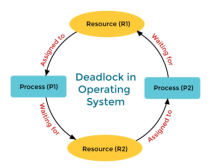
Enter the classroom, motivate students before starting the lesson for their concentration on the lesson, and then write today's topic "Introduction to Deadlock and its Features" on the board.
Begin the class by posing questions to the students to know if they have knowledge of deadlock or not.
Open the PowerPoint presentation slide and start by giving a brief introduction to the topic.
Define deadlock, along with its importance in operating systems, and the basic features of deadlock.
Explain scenario of deadlock by relating it to real-world scenario using its diagrammatic representation in detail.
Explain the necessary conditions for a deadlock to occur, emphasizing the four conditions: Mutual Exclusion, Hold and Wait, No Preemption, and Circular Wait.
Summarize the key points covered in the lesson and re-explain the necessary conditions for deadlock, ensuring that students understand them clearly.
4. Assessment:
Deadlock in OS
During the session, ask questions like,
What is a deadlock?
Can you identify the necessary conditions for a deadlock?
Why are deadlocks considered problematic in operating systems?
5. Evaluation:
Write about Deadlock along with its diagrammatic representation. Also, identify necessary conditions to occur deadlock.